Monday, April 4, 2011

Hola to Bonjour

We passed our time Los Canos effortlessly even though we didn't have the best weather and the whole area was kind of dead due to the low season. Plenty of time spent exploring along the coastline and watching the sun set each day. Our workaway was pretty cruisy. Her main premise was music lessons for her two daughters. Bella taught violin and piano and I was teaching guitar. Apart from that it was a bit of gardening, cleaning, babysitting and playing bastketball with the two daughters. Below is on a coastal walk.
We went for a day trip down to the end of Europe. The most southerly tip at a town called Tarifa. You've never seen so many kite-boarding shops in one town. It is one of the windiest places on the continent. We could spy Africa and Gibraltar through the cloud and rain too.
After finishing up in Los Canos, we headed up to Granada for a day's sightseeing. We spent most of our time inside the Alhambra, which is a palace and fortress complex from the Moorish rulers. An amazing complex full of gardens and palaces intricately decorated with stucco and wood carvings. See the photos. Very similar to Moorish influences we saw in East Africa. From building shapes to the carvings to the bath houses.
We then drove through endless farms of olives, then grapes, then oranges (around Valencia, of course) and then back to grapes. We headed to our next workaway host in the Penedes mountains behind Barcelona, near a small town called La Llacuna. He runs a wine tourism business. The Penedes is probably the second largest wine producing regions in Spain, and specialises in Cava, a Spanish sparkling wine. It stretches from the low-lying coastal areas up into the pine covered mountain slopes.
We worked hard here but also drunk a lot of wine too. I spent most of my time hacking a brambles with a whipper-snipper and chainsawing fallen trees. Bella spent her time cleaning the house and working on databases (however it was really only endless lists of email addresses for him to send stuff too). We tried at least two different wines each night, mostly from wineries around the Penedes but also from Portugal, France and Italy. Cavas, reds, roses and whites. On weekends we visited wineries for a full tour than typed up some Blog articles for his website (click here for mine or Bella's). It was great to have a contact to line up these visits, as it is not like in Australia where you can just turn up and try some wine. Normally it is all organised in advanced and you can pay 20 or 30 euro for the visit.
To detox we got on his bikes and rode around the place. Cycling is super popular in Spain, and the mountains are a very scenic place for a ride. With plenty of lycra out on the roads, we didn't quite fit the mould on our mountain bikes and loose fitting clothes. The problem with cycling around this area was there wasn't much flat ground, it was either up or down. Admittedly the down is great, but the up can be a bit too much at times.

We also fitted in a day trip to Barcelona. We drove to our local train station and 58 minutes later we were in the centre of Barcelona. We used to nearly have tube trips that long within London. We got another dose of Gaudi at La Pedrera and just enjoyed being in a big city again after a while in the regional and rural parts.
We spent three weeks at La Llacuna, from there we moved to the other side of the Pyrennes into France, in the middle of nowhere, near a village called Aleu. The area had a population of 1,200 people in 1890, it's now down to around 200. We've moved from little hills covered in pine trees, to views of massive mountains covered in snow. It's pretty nice. They drive through the Pryennes was great too. Lots of lakes, tunnels and mountains. And no tolls. No tolls since the way down, but i am back in France so now the test begins. We are working on repainting the insides of a 100 year old farmhouse here. And hopefully lots of hiking and visits to the boulangerie.

Photos

Saturday, March 5, 2011

Working Away

With most of the Middle East and Northern Africa in the midst of a revolution, we are off to explore Europe. We settled on Pierre. A 1998 Peugeot 306 Metallic Blue (67,000 miles), with all the options including power steering, sun roof and cassette player. He set us back 1,000 quid.
It had been quite a shock to be back to 4 degree maximum temperatures of London, after living around the equator for 2 months. So we can now say that Simon and Sarah's postman arrives at 12.20pm (with our insurance certificate) and we were then off to Dover to catch a 4pm ferry to the continent. The security guys had a quick glance in the boot, the passport control waved us through like they were controlling traffic and the ticket office man checked our tickets and passport. The trip takes just under 2 hours, and we lost sight of the white cliffs 10 metres from shore, saying goodbye to the English rain and fog.

We arrived on foreign soil at Dunkirk and thought we would just find a road-side hotel for the night and begin the drive the next day. Unfortunately, road-side hotels don't really exist in France (as a side-note, they are everywhere in Spain). So we ended up driving in the darkness and rain, for about 2 hours, until we reached the town of Rouen. Where we finally decided we had to start looking a bit harder, so we headed off the highway. We found an Etap hotel. We checked-in with a vending machine and had a sound night's sleep.

We headed off the next day after a delightful breakfast at the local boulangerie, pain au chocolat et cafe for around 2 euro (Chocolate Croissant and coffee). Welcome to the continent. We drove for around 7 or 8 hours, mostly on expensive French toll roads. Great, quiet roads but we spent at least 60 euro on tolls that day. We made it to Hossegor. A surf town in the south-west corner of France. After spending about 2 hours checking if any of the 6 camp grounds were open, we eventually found out no, and then found a cheap hotel.
The next day we drove through the rainy mountain country in northern spain and then through the wide open nothingness. We made it to Merida and found a camp site open. From here, it was only about 3 hours to our first workaway destination of Zahara de la Sierra. A Pueblo Blanco (white town) in the Sierra de Grazalema. A cool town, perch on a hill, over-looking a lake complete with spanish castle on top. This was to be our home for the next two weeks. Awesome.

To make our money go further in Europe we are using a website www.workaway.info. It connects people in Europe who need some help around their place, whether it be a farm, B&B or whatever. They usually provide food and accomodation, in exchange for about 5 hours of work per day, 5 days a week. Work can be anything from gardening or housework, to helping with construction. It suits us as we get a chance to explore the more rural parts as we have already travelled some of the big cities filled with museums and churches.

Our first hosts were Anja and Gonzalos, a spanish/german couple, with a 3 year old boy and a new born girl. They have a small little B&B and farm with around 60 olive trees. It all went really well. A little bit of work and plenty of time to explore to area, which was great. Lots of little villages and mountains to hike around in. I spent most of my working time on the end of a wheel-barrow, but also helped removing the plaster from the wall on 100 year old stone farm house. Bella did a bunch of things, from housework to sewing to babysitting. We had a mixed bag with the weather, a few rainy days, but also some great sunny days too. Much improved upon London.

The roof of Cinco Lunas, our hosts.
We did two major hikes in the area. One into Garganta Verde, a cool gorge with vultures flying around over-head and one to the top of El Torreon, the highest mountain in the area (around 1600m).
The photo below is of a nearby town called Ronda. They certainly like to build them in dramatic positions.
The little things that make the day's great. Some supplies from the local panaderia (bakery), awesome pastry with custard and covered in icing sugar. 80 euro cents.

We spent 2 weeks in Zahara. We then moved to another workaway in the area, but this time a coastal change. A little town called Los Canos de Meca. It's just south of Cadiz and it is the off-season, so it's very quiet.
I think we should be able to handle it.

Photos

Tuesday, March 1, 2011

AFRICAN ADVENTURE - Tanzania

Wow, sorry, lost internet there for a few weeks. So to finish off the African story.

We caught a bus across the border into Tanzania. It was all pretty standard and nothing too out of the ordinary. Just standard no idea on where to go, just join a line, pay some money to a guy in a uniform, get a stamp and say no to all the guys trying to exchange money. We were still in need of a relaxing beach camping experience and this part of the north coast of Tanzania has quite a few options.

We stumbled upon Peponi Resort, just south of Tanga, and ending up staying for just short of a week. Nothing much to do. A nice quiet beach with no hustle and a nice campground. Perfect. Plenty of lazing about, sun-baking, reading and swimming.
We also relented after 4 weeks and went for a snorkelling trip. It was another great day out in the dhow, with lunch on a white sandbank. The snorkelling was good too. Plenty of healthy coral and little fishes.
From Peponi we headed straight out to Zanzibar. We arrived in Nungwi, in the North. We were surprised both by the beauty of the place and the development. Amazing white sand and turquoise water. Equally amazing amount of resorts stretching for kilometres in either direction. More sun-baking, reading and less relaxing (wanna buy this, wanna go snorkelling, wanna do this tour, etc.).
We then headed down to Zanzibar Town and Stone Town, which is the old part of town. A little disappointing from the too touristy angle, but an amazing place with an amazing history. Made famous by Arab and Portuguese sailors trading there, and was its own state until 1964 when it joined Tanzania. Plenty of wealth in times gone past, looking a little worse for wear now. We spent most of our time eating cheap snacks and walking around alleys looking at doors.
We then headed back to Dar Es Salaam to spend the night before heading up to Lushoto the next day. This is probably the craziest bus station we have ever seen. Both trying to buy our tickets the day before and also catching the bus at 6am the next morning. It doesn't help that it is 10kms out of town. Let's just say there are lots of people and lots of buses. In the end we made it where we wanted to go. And it was great.

Lushoto is up in the Usambara mountains, so with a little bit of elevation we gained some relief from 6 weeks of constant sweating 24 hours a day. Not that I am complaining. Let's just say the 20 quid tent bought in London, doesn't have suitable ventilation for the tropics. Neither do the 0 degree sleeping bags, that spent most of the time rolled up.
After wandering around the green hills for a couple of days, we organised to go for a 3 day hike to a nearby village called Mtae. It was a nice cruisy pace with a good balance between up and downhill, even a few bus rides thrown in. No real peaks to speak of, just a nice view at Mtae. The whole area gets about 2m of rain a year, and when it's not bucketing down, it's sunny. So the whole place in one big veggie garden. Most of the hill sides are terraced and are farmed. Mostly in small family holdings with everything down by hand. About 60% of the population in this area is employed in primary production.

They also have Chameleons.
Lushoto and Mtae both look out into the The Great Rift Valley. Below is near Mtae.
We headed back to Dar Es Salaam on the Friday on one of the just too long bus rides, ended up about 8 hours. We had Saturday and Sunday to kill in Dar Es Salaam, with our flight to Cairo scheduled for 2am on Monday morning (Sunday night). We had a walk around on Saturday, found that most things were closed, including the museum. But we spent about an hour in a air-conditioned book shop and then had a long lunch at a dodgy fast food place. We went up to the rooftop bar at the Kilimanjaro Hotel, which has a nice view, although we couldn't justify the beer when it was 4 times the price of the YCMA.

Sunday there was even less open. Not even the internet cafe at the YCMA where we were staying. We were counting on that to kill a few hours. So we eventually relented around midday and paid the exorbitant price at the Holiday Inn across the road. It was pretty fast internet and as a result I checked a news website for the first time in two months to discover that riots had broken out in Cairo and 300 people were dead. Not great news for the city we were due to fly into in 12 hours.

So we headed to the Airline office, our friends at Egypt Air (see part 1 of African Adventure) expecting the worst. They were closed, but had a phone number. They gave us a palm off for a few hours. So we went around to the office around 3pm, and by 4pm we were booked on flights back to London with Qatar Airways (with a delightful 7 hour stopover from midnight to 7am in Qatar).

So we missed out on our 3 weeks in Egypt. But it could have been worse. We could have been in Cairo when it all went pear shaped and then had to deal with Cairo Airport again. So we have just brought our Europe plans forward.

Stay tuned....


PHOTOS

Thursday, February 3, 2011

AFRICAN ADVENTURE - Kenyan Coast

After our Mt Elgon trek we were about ready for some easy travel so we headed to the Coast. The first port of call was Mombasa. A busy port town and Kenya's second largest city. It's hot, humid and sultry and was great to feel after too long in the UK.

This was our introduction to the history of the coast. The length of the coast has been fought over for centuries by various people. Arabs from Oman, Portuguese sailors and of course the ever present British are the main players. It was a major link between the Far East and eventually Europe, with activity dating back as far as the 12th century. As with all trading centres, there had been plenty of wealth generated at times and some subsequently squandered. Ruins are scattered along the coast. The wealth was generated by all the nice commodities: ivory, spices and slaves. The area has a different feel and is due the Swahili culture. The old parts of town are mazes of tiny alleys with highly ornate wooden fixtures, including doors, windows and balconies. Islamic religion is more prominent and this is reflected in the clothing (both women and men) and mosques with their regular call to prayer (including 5am). A crazy mix of Africa, Arabic and Eastern cultures.
A mosque at sunset above, and a typical carved door below.
The main attraction in Mombasa is Fort Jesus. A fort built by the Portuguese around th 15th century. A coral rag castle. A lot of the construction in this area is built by carving coral blocks out of the ground, left over from higher ocean levels a million years ago.
Mombasa didn't really satisfy our coastal cravings as it is a bustling city. So after a few days we headed up the coast to Malindi. An Italian resort town where they flock to escape their Winter. Being a whitey we were greeted with 'Ciao' by all the local kids. This was great for a bit of Italian influence in our diet. We had a delicious pizza and numerous gelato excuses in Malindi. However the beach wasn't quite the picture the guide book painted, as the whole ocean was a vibrant shade of red, thanks to the all dust being washed down the rivers from a bit of rain inland. Great. It was also our introduction to the hustle on the beach. For the next 4 weeks we were offered snorkelling trips multiple times on a daily basis. Also jewellery and whatever else they could think of.
We did however find a saviour. Watamu, a smaller town about 30 minute drive down the road. A beautiful white sandy beach, crystal clear water and less hustle. So we spent the next two days doing day trips because we couldn't be bothered changing hotels.
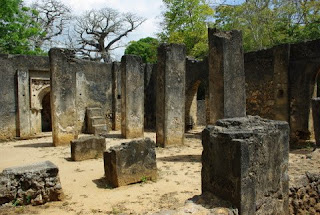
We also did a day trip out of Malindi to the Gede ruins. A city of ruins from the 13th century that was only discovered 50 years ago. The city was quite developed with a large outer wall, a large mosque, numerous water wells, toilets and flowing water. All of this wealth created by the trade on the nearby ocean.
We then caught a long bumpy bus up to Lamu. Lamu is on an island and there are no roads and no cars. Everything arrives by boat. Donkeys are the work-horses of the island. Lamu was great and we ended up spending nearly a week here. So nice and peaceful without any road noise. Wandering around the narrow alleys and exploring the city. Or wandering up to the nearby beach. Time passed effortlessly.
One of our places we stayed in Lamu. Very cool catacomb of concrete.
We spent Christmas in Lamu. Breakfast was a simple affair of coffee, fresh fruit and pastries. We then went out to a big seafood lunch (Lobster and Crab). And had a casual dinner and a few drinks with some friends.

Boxing Day we celebrated in typical style with our own little sailing trip. Dhows (the local boats), have been hand crafted here for centuries. They are completely made by hand, everything down to a hand-sewn sail. They are amazing and sail really well.
We went out, did a bit of fishing and then came back for BBQ lunch on the beach.
After Lamu and clocking up a month in the continent, we were ready for another dose of animal action. So we headed back down to Mombasa and booked in for a 3 day safari through Tsavo West and Amboseli National Parks.
More up close and personal interactions with the animals. Plenty of elephants although the animals weren't as prolific as the Masai Mara. We were expecting to be camping, but ended up in some amazing lodges. One of those mis-communications in our favour. The one below was our first night. We awoke to a herd of buffalo feeding in the morning. This is on top of the elephants drinking throughout the night and a leopard wandering across the one spot light they had set-up.
Tsavo West had some amazing landscapes but a lot of vegetation, which makes the animals harder to spot. But when you do spot them they are close.
Amboseli was big open Savannah plains. With huge herds of elephants and Kilimanjaro looming nearby.
Crystal clear Kilimanjaro (5,800m asl) at 5:30am.
After our safari we went back to Mombasa and hung out on the southern beaches for a few days. These are very touristy. We did manage to get away from the crowds in a sacred forest called Kaya Kinondo. A small patch of forest that is believed to be sacred by a local tribe. It was great to wander around and here the stories and beliefs. Bella is powering up by hugging a tree.
Next is Tanzania.

Photos