Now for a writing entry.
When we made it back to Uyuni after the salt plains, we had thought that our time in the Landcruiser was over. We had to go to the ATM in Uyuni (because there was no ATM in Tupiza) to get money out to pay for the tour. While we were waiting for the ATM to start working, we started talking to some tourists. Whereupon we discovered that while we were away, the miner's union had decided to start a protest over something. This somehow translates in Bolovia to meaning there are blockades on all the major roads and hence no buses running. This particular tourist just managed to secure a seat on a bus to La Paz in 3 days time.We confirmed these rumours to be true-ish (truth is quite hard to find in Bolivia). This threw our plans into a spin, as we were planning on heading to Potosi either that night or the next day. But with a whole heap of tourists stuck in this town, we weren't sure when we could get a bus or even if we could get a room for the night. Our back-up plan was for us to go back to Tupiza with our tour guides. It was a free lift, apparently only 4 hours away and we thought it would be less chaotic in Tupiza. So off we went, back to Tupiza.
It all started ok. A few more random stops in town for no apparent reason and we were off. Although we weren't sure if the road would be blocked. About an hour out of town and we stop at a few houses. Our guides ask a few questions and seem to get a satisfactory answer so we push on. About a 1/2 hour later and it is starting to get dark. Luis (or driver) turns the headlights on and they work for about 15 minutes. All of a sudden we hit one too many bumps in the dirt road and both of the headlights stop working. We come to a stop. The sun is down but there is still some light. Luis begins his mechanical skills that we had observed on the salt plains tour. He starts hitting everything from the dashboard to the headlights themselves. Surprisingly nothing seems to work. He gets a little more technical and has a look at some fuses and other things. Eventually he gives up and we continue driving with what little light we have (basically none). We hit just the right number of bumps in the road and the headlights return, for all of a minute before they disappear again. We stop again. More thumping, bashing, etc....By now it's completely dark, we are in the middle of nowhere, we're still at 3500m in a desert so it is freaking cold, Bella is feeling average from 4 days in a car and I am feeling not so good after too much sun and not enough water on the salt plains.
Eventually Luis is back in the car and we push on again. This time with every conceivable idea, idiotic or not. We drive along with the window down and our tiny torch out the window. This lasts until the batteries die which , thankfully, isn't long. We have spares but are not telling him. Next, is driving using the hazard lights. The intermitant flashes and annoying sound does not do well for my headache. We pursue with this method for longer then you would think would be possible. We also tried driving without any lights. Eventually sanity pervails and we stop again. A few cars go by but eventually one stops. He has a look under the hood but again, to no success. He does however agree to let us follow him to the nearby town. This is the most logical Bolivian solution i have seen yet. We make it to the town about 9 pm and decide to stay the night. 4 hours since we left Uyuni.
The next morning we wake up about 7pm to a frozen toilet and column of ice between the tap spout and the sink. But also to no car. We panic slightly, but figure it should be easy enough to find a lift, whether it is a bus or other returning tour group. We get our bags ready and just as we walk out the door and there is Luis and the car, and about 6 other people who are all going to cram into the car for the trip to Tupiza. Making 9 in total in the Landcruiser we head off. This drive was actually quite enjoyable with more of the Wild West scenery that this area is famous for. We made it into Tupiza about 11.30am completely exhausted and crashed into a hostel for a shower (my first in 5 days) and a sleep. The 4 hours Luis had originally promised us had turned into a 8 hour marathon over two days.
Our next step was to find out what was going on with these road blockages and if we could make it to Potosi. The next day we go to the bus stand and after a number of blunt 'no's' we find one bus company who is running a service at 10am the next day. Sceptical but satisfied, we buy tickets. We turn up the next morning at 9am (as we were asked to) and begin to wait. Just before 10am the bus office gets really busy, then really quiet. We become sceptical and tried to find out what is going on. Turns out our bus was now leaving from 12pm from the 'tranca'. After asking a few people we finally determine this is the city boundary. Our bags are in the ticket office, with everybody elses, and we ask about them. We are assured a number of times they are being taken together to the bus. So we accept this and head of to the city boundary in a taxi. We wander about aimless, get some conflicting information, but eventually determine it is 2km down the road past all the trucks. It is here we determined the road blocks were not governmental but were the trucker's union. We were running short on time, but managed to make the bus at 12pm. When we got there, the bus driver drove a further 1.5km down the road, while we had to walk. Then had spoke some very fast spanish, with something about gasolina and rode off back to town on a bicycle while we all waited at the bus. About 1.5hrs laterhe returned. We boarded the bus and we were off. At this stage we were also worried about our bags but the bus driver looked a bit too preoccupied to bother him with our broken spanish. We made it about 30 minutes up the road where we stopped again. After waited for about 10 minutes a ute with a 40 gallon drum of petrol turns up. Similar to Fiji, all the men get off the bus to help load it onto the bus. 4 people do the work while the rest stand around and watch. Apart from that it was a pretty standard 8 hour bus trip along mostly a dirt and bumpy road in a cramped Bolivian bus, not the Argentinian comfort we were used too. We arrived in Potosi about 9.30pm after getting to the bus stand at Tupiza at 9am.
After spending 8 hours thinking about, our fears were confirmed when we arrived in Potosi and our bags were not. The bus driver told us to come back at 4pm tomorrow and they will be here. So a little concerned but lacking any alternatives we decide to head off to our hostel. We relent to one of the taxis who had been hassling us for a ride. As we are getting in another girl asks if we are going to a hostel and if she can get a lift. Without thinking much of it we accept. As we go around a nearby corner a man hits the back of the car. We stop and he asks for the driver's licence as he is a police officer. He then jumps in the car and the taxi takes off again. He says that he is a police officer, shows us a dodgy looking ID, and asks to see our passports. I am sceptical about handing anything over. The girl next to us agrees willing. I eventually lie and say they are in our other bags. He keeps on pushing the matter but we continue not to give him anything in our broken spanish. Finally a language barrier in our favour with me and Bella being able to talk. Finally he gives up on passports and then moves onto money. Again the girl next to me agrees. I am reluctant but hand over 60 Bolivianos (10 aussie) as luckily it is all i had in my wallet. He sniffs and starts asking about drugs and hands it back. He then begins on asking for drugs, US dollars, Euros and going back to the passports again. All this while we're driving around a town we don't know. He starts becoming more agitated as he is getting nothing out of us. We persistently ask to be taken to the police station, our hostel or just stop the cab. Eventually they agree to the station. We start heading up some dark streets and eventually the car stops. The excuse offered is we are out of gas. I tell bella to get out but the door is jammed. The 'policeman' then reaches over and opens the door for us. We get out and run for a bit, but they are not following us. We walk as to not arouse more attention to two gringos at night in this area. Go down some stairs, around a corner and find some mothers with their kids. We ask if there is a taxi stand nearby. There is and we follow them to it. Sceptical about getting in a cab again, an old guy in a newish car turns up. We ask if he knows the hostel and get in. Thankfully he drops us at the door. We get a room and crash again, completely exhausted again. But with nothing missing, except our packs from the bus. Thankfully they turn up the next day too with a bit more patience and waiting.
Bolivian tavel is living up to its reputation.
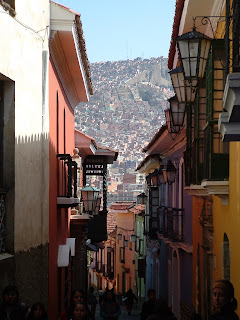

 San Pedro prison on the right for those who know its story. Smack bang in the middle of La Paz.
 And Bella sitting next to a pretty garden.


 Some nice tight corners above. And the picture spot below. With a 600m drop down the edge.
 It was 64km of road, in about 6 hours dropping 3345m of vertical descent. A great day out!!


 But life goes on. Mine does and so does his. Hopefully I made his life better for the time that I was with him. He definitely made an impact on me.


 Rico

